
This article also published at NUWSP website at: https://nuwsp.web.id/artikel/7164
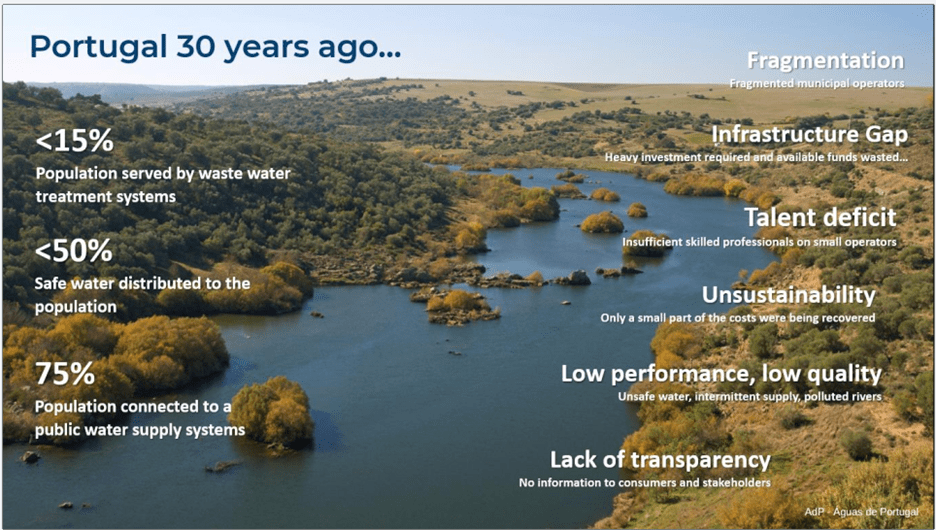
One of the important things from the 10th World Water Forum Summit in Bali on 18-24 May 2024 was a special session presented by Aguas de Portugal (AdP). On that occasion, the transformation of the water and sanitation sector carried out by Portugal since 1993 was explained. This presentation was considered relevant because according to PUPR Minister Basuki Hadimuljono, water supply and sanitation services in Indonesia were similar to conditions in Portugal in the past. Currently sanitation services in Indonesia are less than 15%, and water supply is still less than 50%. (Kompas.com, 2024)

Meanwhile, the government is targeting Indonesia to achieve Golden Indonesia 2045, including in the water sector. To pursue the Sustainable Development Goals (SGDs) target and the vision of a Golden Indonesia, President Joko Widodo issued Presidential Instruction No. 1 of 2024 concerning the Acceleration of Drinking Water Supply and Domestic Waste Water Management Services. (Ministry of Public Works and Housing, 2024)
On the occasion, AdP Vice President Antonio Ventura said that previously water services in Portugal were unstable, inefficient, and not transparent. AdP itself is a state-owned company which was founded in 1993 and works commercially in operating the water sector. Today, AdP supplies 99% of the safe drinking water and 86% of the sanitation in Portugal. But how did AdP work to be able to achieve the achievements it has today?
Portugal is a country with a population of 10 million people, with a Mediterranean climate with beaches as tourism potential. Unfortunately, there is a large gap in terms of demographics between rural areas and the coast. Likewise with the flow regime (flow that influences layer configuration) from year to year. Most of Portugal’s water sources come from dams, considering that many river basins in Portugal intersect with Spain. Meanwhile, 70% of water needs are used for irrigation.

In 1986, Portugal became part of the European Union (EU)/European Economic Community (EEC). Until 1992, Portugal had experienced little improvement in drinking water and sanitation. Later, EU grants were directed towards local and separated solutions, but were not nationally coordinated. According to Antonio Ventura, at that time the city government was only responsible for drinking water and sanitation systems, but their performance and capacity to invest were still very limited. As a result, even though 75% of the population can access drinking water, the water supply cannot be accessed 24 hours a day. Apart from that, less than 50% enjoy safe drinking water.
Finally, in 1993, Portugal carried out legal sector, institutional and professional management and organizational reforms to improve drinking water and sanitation services. This reform is important to ensure sustainable development of water services. Massive changes in regulations and harmonization between institutions also occurred, involving the participation of the central government, city governments, companies/corporations with legal entities, and the private sector. One of them gave birth to the “Multimunicipal Systems” management model which is controlled by the state through AdP and all city governments.

In this system, it is known, among other things, that all city PDAMs are the main water service providers which are supplied to each city through internal contracts awarded by the central government. This contract includes a capital investment plan during the term of the contract. The full cost recovery (FCR) tariff is determined for a period of five years by policy makers based on the tariff and investment plans submitted by PDAM. The benchmark for success is carried out by the Central Government by monitoring the PDAM performance index (KPI) every year.
Based on data on key economic and financial indicators as of December 2022, it is known that AdP’s achievements include, net profit of 100.3 million EURO, total assets of 6.29 billion EURO, investment of 237.8 million EURO, safe drinking water service of 99.6%, waste water treatment 93.4%, BUMD with a 100% environmentally friendly management system, and BUMD with 100% quality management certification.
The lessons learned in this case are:
- Corporatization—the process of changing and restructuring state assets, state institutions, or city/regional institutions into corporations or business entities (Investopedia, 2021)—is considered very important for the sustainability of drinking water services.
- Sustainable Cost Recovery (as the basis for determining service rates) is a must.
- Drinking water and waste water treatment services should be managed by the same party, in order to obtain sustainable waste water management solutions.
- Assessment using indicators (KPI) is very important for transparency in the implementation of activities.
- Institutional Framework or institutional framework—The legal and institutional framework is a broad concept and concerns the functions of government, private companies, political jurisdictions, the judicial system, legislative bodies, and regulatory bodies (Science Direct, 2022)—which is clearly needed for changes in the sector concerned to become better.
Regarding Portugal’s success in the field of drinking water services, sanitation and solid waste management, Ana Teresa Albuquerque, Executive Board Member of the Water and Waste Services Regulation Authority (ERSAR) of Portugal, explained in her article in Smart Water Magazine Portugal in 2020. According to him, Portugal’s success in the drinking water and sanitation sector was realized thanks to the government’s political commitment, targeted research and implementation, accompanied by comprehensive, integrated and stable public policies, as well as the involvement of all stakeholders, and the availability of funds. (smartwatermagazine.com)

How does AdP’s achievement relate to NUWSP?
From AdP, the NUWSP Team can take the following lessons:
First, Integrated Urban Services Management System: Patent holder in the integration of drinking water supply, sanitation and waste management (Technical Model – Aquamod) as a guarantor of operational quality and financial sustainability (Financial Sustainability)
Second, Information Management through Management Information Systems (SIM): One of the keys to AdP’s success in carrying out operations across administrative boundaries in around 220 municipalities (equivalent to districts/cities).
Third, Integrated Asset Management: Maximum implementation of management policies, asset management and risk management by prioritizing cost efficiency to ensure sustainability with affordable water tariff services.
Fourth, Tailor-Made Solution: Adjustment of drinking water, sanitation and waste management which tends to be difficult for one-fit-for-all, especially regarding geomorphology, demographics, environmental conditions and social conditions. For example, a Small-Scale Waste Water Treatment Plant (SWWTP) is prepared and built to provide services in rural/remote areas and for urban areas it is prepared, built and managed by large-scale facilities/assets.
Fifth, Open Doors Approach: This is a good approach to foster collaboration with various stakeholders.
In the Coordination Meeting for the Follow-up Event of the 10th World Water Forum at the PUPR Ministry on Wednesday, June 19 2024, the results obtained included, among other things, the need to carry out institutional transformation of SPAM; SPAM institutional transformation roadmap starting in Bali Province; initial framework for institutional transformation of SPAM in Indonesia;
Institutional transformation was carried out starting from changes in the authority to set tariffs (Permendagri No. 21/2020, amendment to Permendagri No. 71/2016) which was delegated to the provincial government to provide reference rates and determined by the mayor/regent based on the proposal of BP and BUMD AM. Now everything is determined by the central government, namely: the National Natural Resources Council as the regulator provides input to the Minister of PUPR; determination of national drinking water tariffs by PUPR Ministerial Decree; BUMN implements national drinking water tariffs; BUMN implements SPAM nationally, in line with the designation of drinking water as a National Strategic activity.
The aim of institutional transformation is to eliminate issues of political interests, accelerate 100% adequate drinking water, ensure that the tariff applied to customers is a tariff that guarantees the fulfillment of 3K (Quantity, Quality and Continuity), full cost recovery (FCR) and equity (fairness).
Hopefully Indonesia will be able to fulfill the ideals of a Golden Indonesia 2045 by providing 100% drinking water services and domestic waste water management services for all Indonesian people.
References:
- Kompas.com (2024): Air dan Sanitasi Indonesia Dinilai Mirip Portugal 30 Tahun Lalu, diperoleh melalui situs internet: https://lestari.kompas.com/read/2024/05/24/122440386/air-dan-sanitasi-indonesia-dinilai-mirip-portugal-30-tahun-lalu
- Kementerian PUPR (2024): Gapai Indonesia Emas 2045 Sektor Air, Menteri Basuki: Kuncinya Reformasi Kelembagaan, diperoleh melalui situs internet: https://pu.go.id/berita/gapai-indonesia-emas-2045-sektor-air-menteri-basuki-kuncinya-reformasi-kelembagaan
- Science Direct (2022): Institutional Framework, from “Sustainable Resource Recovery and Zero Waste Approaches”, 2019, diperoleh melalui situs internet: https://www.sciencedirect.com/topics/earth-and-planetary-sciences/institutional-framework#:~:text=Legal%20and%20institutional%20framework%20is,legislative%20bodies%2C%20and%20regulatory%20agencies.
- Investopedia (2021): What is Corporization?, diperoleh melalui situs internet: https://www.investopedia.com/terms/c/coporatization.asp#:~:text=What%20Is%20Corporatization%3F,directors%2C%20management%2C%20and%20shareholders.
- Smart Water Magazine (2020): Portuguese experience on the aggregation of water supply, sanitation and solid waste utilities, diperoleh melalui situs internet: https://smartwatermagazine.com/blogs/ana-teresa-albuquerque/portuguese-experience-aggregation-water-supply-sanitation-and-solid
- Catatan Notulensi Koordinasi Tindak Lanjut Acara World Water Forum 10th antara Rentek Direktorat Air Minum Kementerian PUPR dengan RMAC NUWSP, 19 Juni 2024.
Photo Credits:
- Dokumentasi RMAC-2 NUWSP (2024)
- Kompas.com (2024): Air dan Sanitasi Indonesia Dinilai Mirip Portugal 30 Tahun Lalu, diperoleh melalui situs internet: https://lestari.kompas.com/read/2024/05/24/122440386/air-dan-sanitasi-indonesia-dinilai-mirip-portugal-30-tahun-lalu
- Ventura, Antonio. (2024), Aguas de Portugal: Transforming Portugal’s Water Sector, Special Session on The 10th World Water Forum, Bali, 2024
Written and Edited by:
Nina Firstavina, S.E.

 The Neferland
Leave a comment